

A Harvard Business Review (HBR) article circulating this month shows that AI is creating the foundation for a whole new wave of burnout. As someone who teaches organizations about AI, I’m not surprised at all.
To explain why, I need to briefly unpack a countervailing narrative: AI as time-saver.
Efficiency has emerged as one of AI’s biggest value propositions in the modern workplace. This is because some AI tools are exceptionally good at quickly executing certain tasks that tend to be much more time-intensive or difficult for most humans.
Predictive analytics tools can crunch huge data sets in a fraction of the time it would take a junior employee. “Vibe coding” platforms like Cursor can spin up fully functional websites or apps in minutes (vs. hours or days for a human software engineer). And every few months, the underlying technology gets meaningfully faster and more capable at performing many common workplace tasks.
For companies that employ people to do any kind of pattern-oriented, repetitive work—the kind of work AI and automation tend to tackle adeptly—this represents a fundamental shift in business model. Simply put, it means that much greater outputs will be possible with far fewer labor hours.
For that reason, we’ve seen CEO after CEO come out predicting an AI-enabled shift to a four-day workweek, three-day workweek, two-day workweek, or (in Elon Musk’s case) zero-day workweek in the coming years.
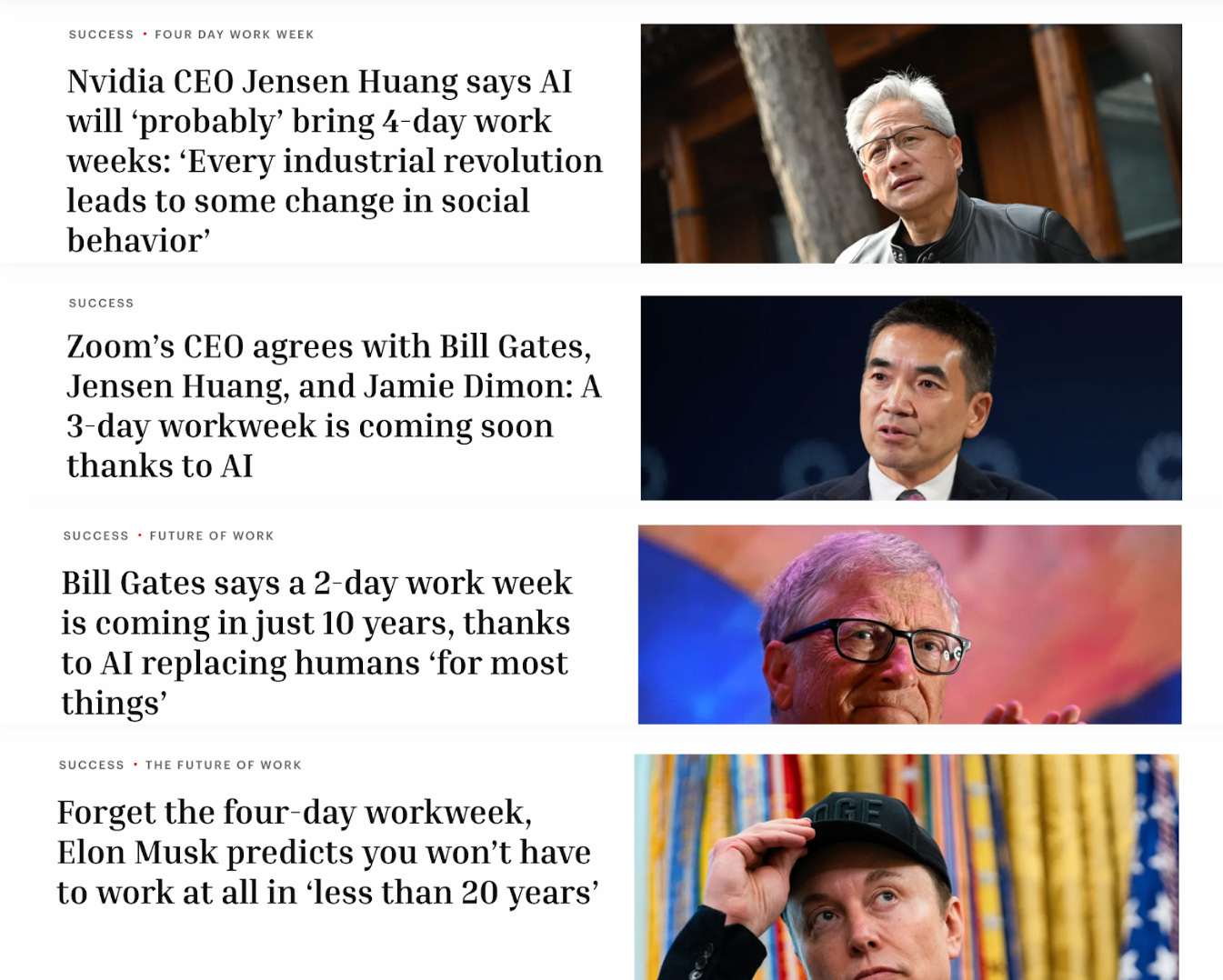
This is a nice picture to paint, especially because most Americans support a shorter workweek. (It probably goes without saying that these predictions also make great marketing for the companies selling AI products.)
But consider the reality for these incredibly wealthy CEOs and the incredibly valuable companies they run. Jensen Huang, CEO of Nvidia, claims that he works seven days a week, holidays included; Elon Musk does too. Tesla’s Vice President of AI and Autopilot Software recently warned his staff that 2026 will be the hardest year of their lives. As of this month, Microsoft is mandating that employees work from the office at least three days per week.
Like all general-purpose technologies, AI will change how we work. It will also change our relationship with work.
But workplace culture is the container that shapes—and limits—who feels the benefits, and how transformative that change can actually be.
A case study: AI-powered time savings in the social sector
Nonprofit work is notoriously taxing, which is why employee turnover tends to run higher in nonprofits than in other industries. In 2025, these trends only intensified: 78% of nonprofits reported rising demand for their programs and 90% of nonprofit leaders said they were concerned about burnout—their staff’s and their own.
I decided to treat my own organization as a test lab for a different future. So last year, I started surveying the Compass Pro Bono team about the value they were getting from AI at work. (We had rolled out access to business-grade AI tools and done some thorough team-wide training in late 2024.)
One of the questions I asked: How many hours per week do you estimate AI saves you, on average?
In January 2025, the average time reclaimed (per individual) was 4-5 hours/week. By June, it was 10-12 hours/week. These were of course guesstimates, and averages were being driven up by power users—but even when I dug into individual responses, it stood true that at least some people on my team felt that using AI tools was allowing them to “get back” the equivalent of a full workday. (Beth Kanter and Allison Fine call these freed-up hours the “dividend of time,” which I find to be a useful packaging for this idea.)
So where was that dividend of time actually being reinvested?
Like most nonprofits, we’re a small team (~20 people) with a lot on our plates. Going into these surveys, I feared that endless to-do lists would absorb any tangible benefit our team might feel from AI-powered efficiency gains.
In other words: if you save an hour using AI, but it gets filled up automatically with “the next thing,” what’s the real value-add?
That was my fear. So I asked my team.
Here’s what they actually said about where their time savings were going (June 2025):
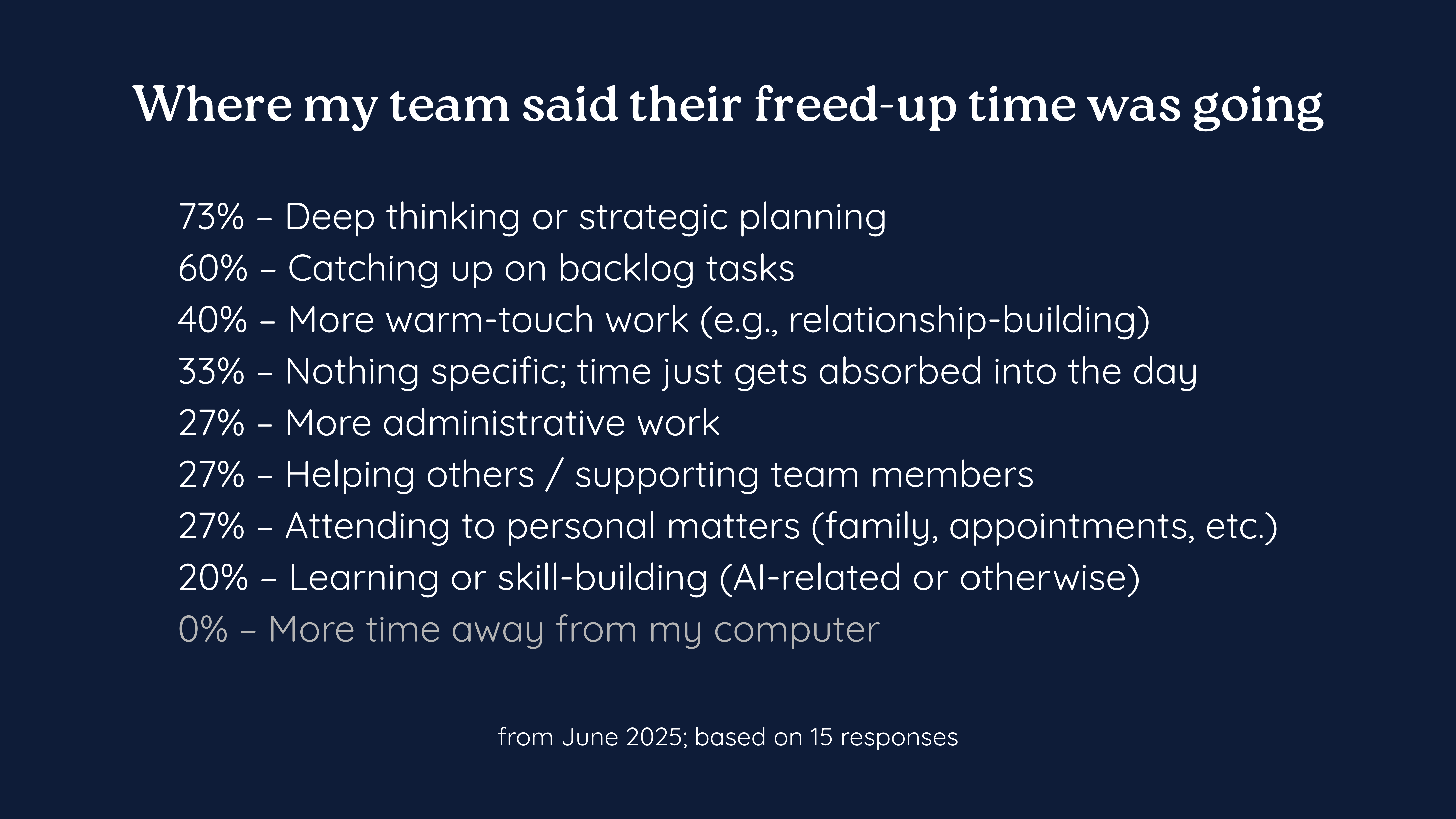
These results told me a few things.
First: the prevalence of “catching up on backlog tasks” suggested that my teammates had a lot on their plates—no surprise there. (In fact, when I asked staff at five other nonprofits in our network the same question, that came out as the #1 answer. I’ve included those full results at the bottom.)
I was heartened that many on our team said that they had successfully repurposed freed-up time to the kinds of activities that really move the needle on our human-facing mission: deep thinking, strategic planning, and warm-touch work. Seemingly, AI and automation were helping with repetitive, mechanical processes while humans focused on the strategic and relational work only they could do.
But one data point stuck in my mind.
I’d added “nothing specific; time just gets absorbed into the day” as a response option to gauge the validity of my hypothesis about endless to-do lists. And it seemed to ring true, at least for ⅓ of my teammates.
Which brought me to a bigger question:
What if we all wake up in 2030 to find that AI is powering most of our day-to-day tasks, but doing work just feels…the same?
That line of thinking sent me down a research rabbit hole. What I found there was an unlikely pattern.
Enter: the impact treadmill
It turns out that something predictable happens seemingly every time a powerful new technology enters the workplace. This is usually how it goes:
1) new technology arrives and promises efficiency/speed gains
2) already resource-constrained, orgs decide to “10x our impact” using that new tech*
3) new tech accelerates the pace of work; that faster pace becomes the new normal
4) when the dust settles, staff feel the squeeze (without feeling the benefit)
*For some sectors, you might swap “impact” for “productivity” or “profit.”
I’ve begun calling this pattern the “impact treadmill,” adapted from the hedonic treadmill. It’s pretty much exactly what the HBR article (based on research at UC Berkeley) warned about:
“In our in-progress research, we discovered that AI tools didn’t reduce work, they consistently intensified it…we found that employees worked at a faster pace, took on a broader scope of tasks, and extended work into more hours of the day, often without being asked to do so.”
With AI’s rapid evolution, this pattern is unfolding at a breakneck speed right now. But the pattern itself isn’t new. Look back 10, 20, or even 50 years and you can find similar cycles:
Late 2010s: Slack promises frictionlessness, delivers overwhelm
Early 2010s: Smartphones promise connectivity, deliver distraction
1990s–2000s: Email promises efficiency, delivers inbox overload
1980s: Computers promise productivity, deliver complexity
If you’ve lived through any or all of these transitions and find yourself working more (or harder) than ever today, you know exactly what this feels like.
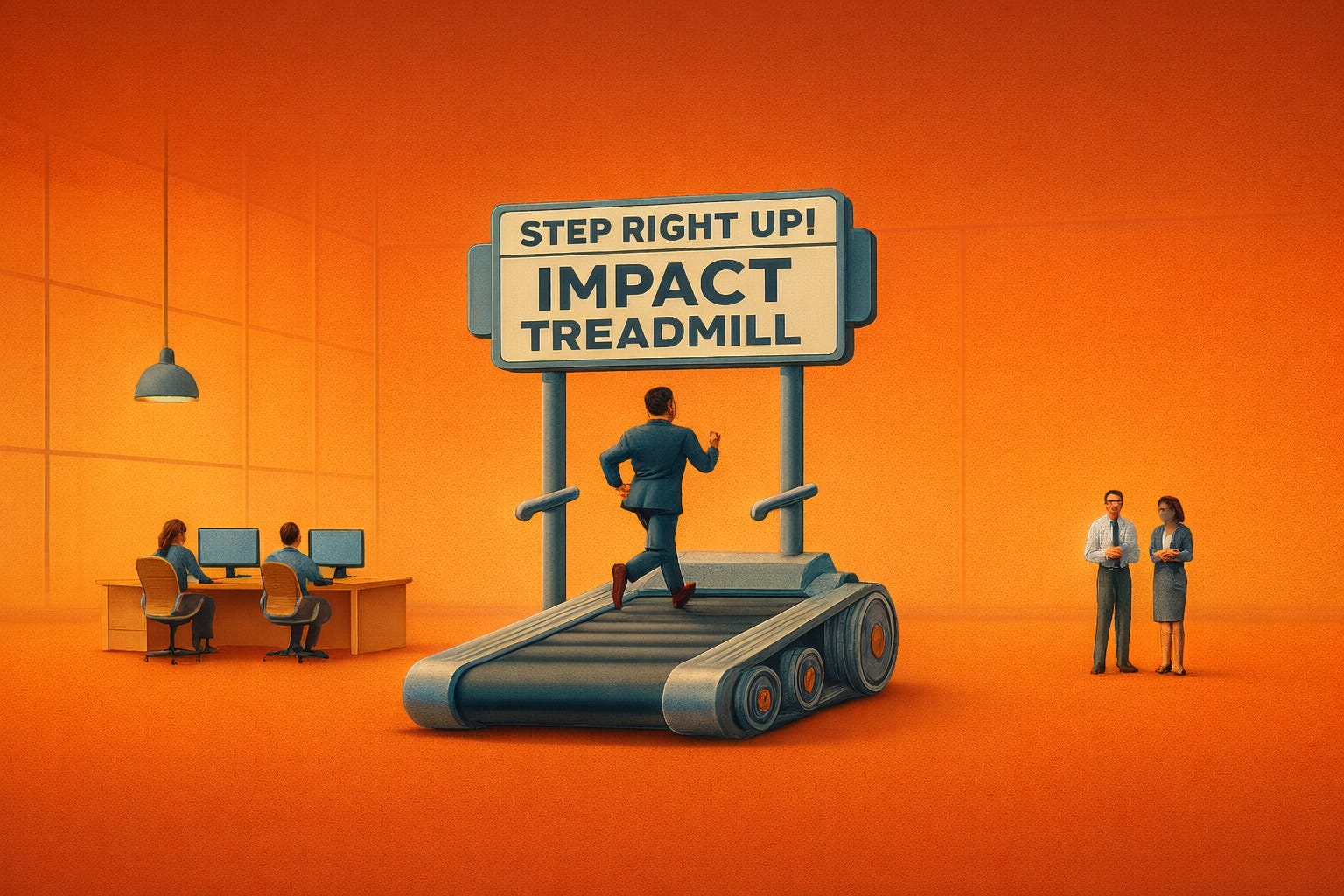
It’s not that these new technologies are bad; it’s just that they’re emphatically NOT neutral. And for whatever tedious tasks they suck up, they leave in their wake an expanse of complex new systems for us to learn, oversee, and administer.
We’re seeing this play out in real time with AI tools, too. When an AI tool gets something wrong, at least some of my previously freed-up time now has to go toward fixing its mistakes. In some cases, that fix (or second attempt, or third attempt) ends up making the task take longer than it would have if I had just done it on my own. We might call this the “AI management tax.”
An Inc. article from December captures this challenge vividly:
“When an AI drafts a report, someone still has to verify its claims (please, do not forget this!), check for bias, and rewrite the parts that don’t sound right. When an agent summarizes a meeting, someone has to decide what actually matters. Automation doesn’t erase labor; it just moves it upstream, from execution to supervision.”
From an organizational perspective, the crux of the problem is this: When executives catch onto the productivity gains AI can enable, they tend to adjust their expectations without accounting for the human cost that efficiency incurs. Meanwhile, employees are asked to rapidly learn new tech and supervise new systems…all while the goalposts shift around them (and typically without any positive adjustment to their working hours or compensation).
THAT is how workplaces drive burnout with AI—not despite it.
The remedy is harder than we think
So here’s a question for you.
If you were gifted 10 extra hours in your week—truly free, unspoken-for hours—what would you do with them?
I’ve asked this question to a lot of people. Almost nobody says “catch up on email.” They say things like: finally write that strategic plan. Have a conversation with that long-neglected donor. Build out the program idea that’s been sitting in a Google Doc for six months. Go out and hire an intern, or apply for a grant, to create sustainable capacity.
Or…rest. Recovery. Play. Time with family. Time away from screens.
Now compare those visions to what actually happens when people save time with AI at work. Boston Consulting Group research tells us that the #1 activity is performing more tasks. In an Upwork survey, 77% of workplace AI users said that AI had actually added to their workload. A wry headline in July 2025 observed: “Your Prize for Saving Time at Work with AI: More Work.”
Perhaps the most visceral example is Slack, which in 2024 rolled out an internal AI tool that apparently saved users 97 minutes of “administrative time” per week. Where did that newfound time go? Employees didn’t know how to use it—so, in the CEO’s words, “they were still focusing on the work of work.”
The work of work.
This is the impact treadmill in action.
Slack rolled out some transformative new tech. It created real space for their people. And then—like magic!—that space disappeared. The container of workplace culture hadn’t changed shape around AI initiatives; it had just been emptied out and filled right back up.
There’s actually a name for this phenomenon: Parkinson’s Law. It’s the idea that work expands to fill the time allotted for its completion.
You’ve probably felt it before. When you have five days before a grant deadline, the work can stretch to fill those five days; when you have five hours, it somehow gets done in five hours.
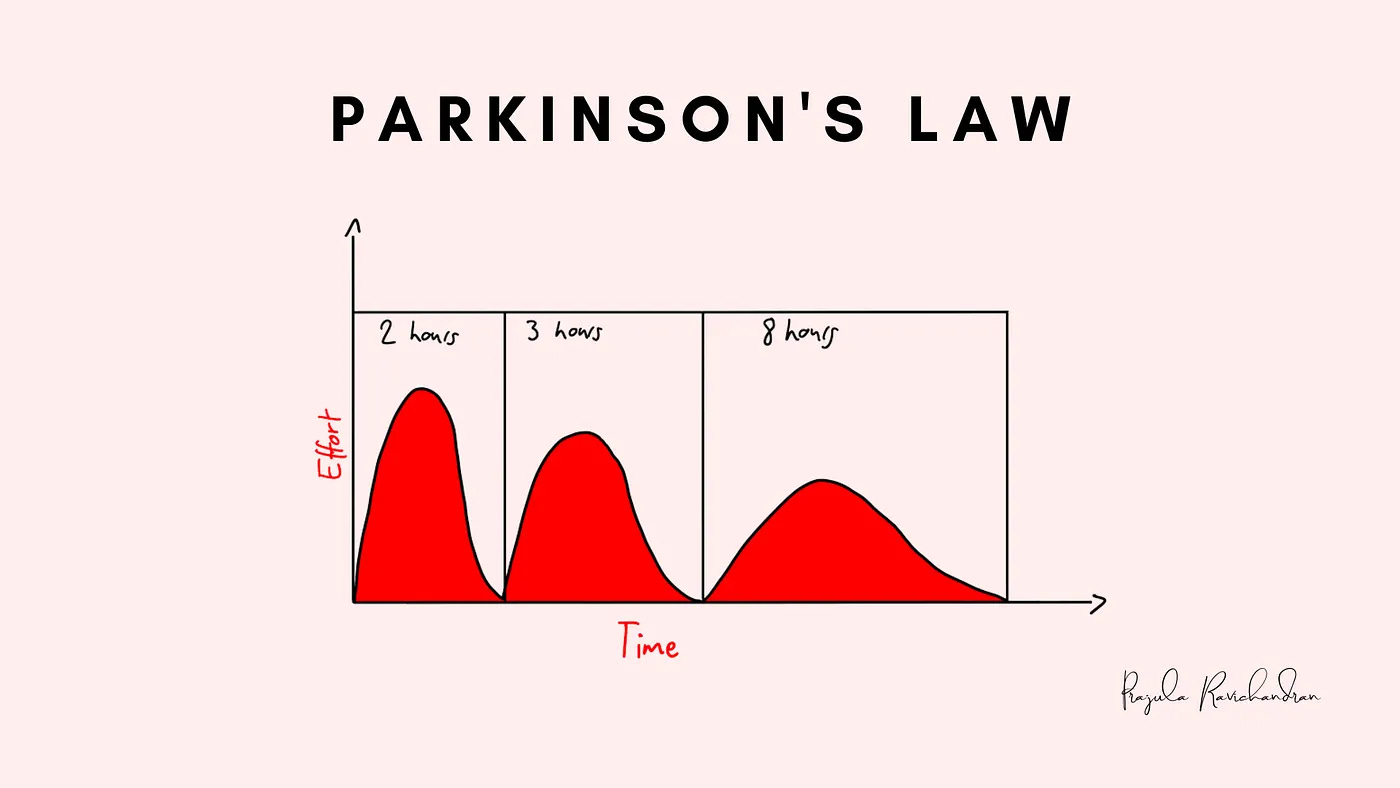
The same applies to our workweeks as a whole. Many of us have no problem filling up our 40 hours—and frankly, we would probably be similarly productive if we added or subtracted 10 working hours from our week. The exact number is arbitrary, but the pattern runs deep.
AI is just beginning to create enormous pockets of open space for us to use as we wish. But right now, Parkinson’s Law is swallowing them whole.
Stepping off of the impact treadmill
So…what’s the solution?
Well, this is complex, iterative work; I won’t pretend there’s one simple answer. But I do believe that whatever answers we co-create will start with something deceptively simple: holding the time.
When you reclaim time or capacity using AI tools, don’t just let your space fill back up. Don’t let the next thing on the to-do list rush in automatically. Pause and ask yourself: what would be most meaningful right now—for me? For my team? For our mission?
Maybe that’s deep strategic work. Maybe it’s relationship-building. Maybe it’s rest! (Really.) Only you can answer that question. But it takes time and space to arrive at those answers, and most of us probably haven’t made that time or space yet.
It’s also worth noting that it’s exceedingly easy to get in your own way here.
Yes, this is an organizational design challenge: organizations with a culture of overwork may find that AI amplifies that culture if it’s not adopted thoughtfully, while organizations that treat AI integration as an IT problem (vs. a people/culture/change management challenge) will likely struggle when this new wave of burnout hits.
But I know firsthand that culture isn’t just imposed from the top down. I grew up in a family that always valorized hard work, so I came to valorize it too. I also feel a calling to my organization’s mission, and I happen to enjoy what I do—so it feels natural for me to just keep running down my to-do list when space opens up.
If I neglect to hold the time I reclaim with AI, and to thoughtfully repurpose it, I may have to contend with the reality that I’m driving myself toward burnout. But I know, from surveys and now from experience, that there’s another option.
What does leadership look like right now?
As an individual contributor, my job is to get ruthlessly intentional about my time. As an AI integration leader, my job is to give people explicit institutional permission (and tools) to do the same.
At our last staff retreat, I asked everyone on my team to write out a few words describing how they wanted to feel using AI and coming to work a year from now.
This is what emerged:
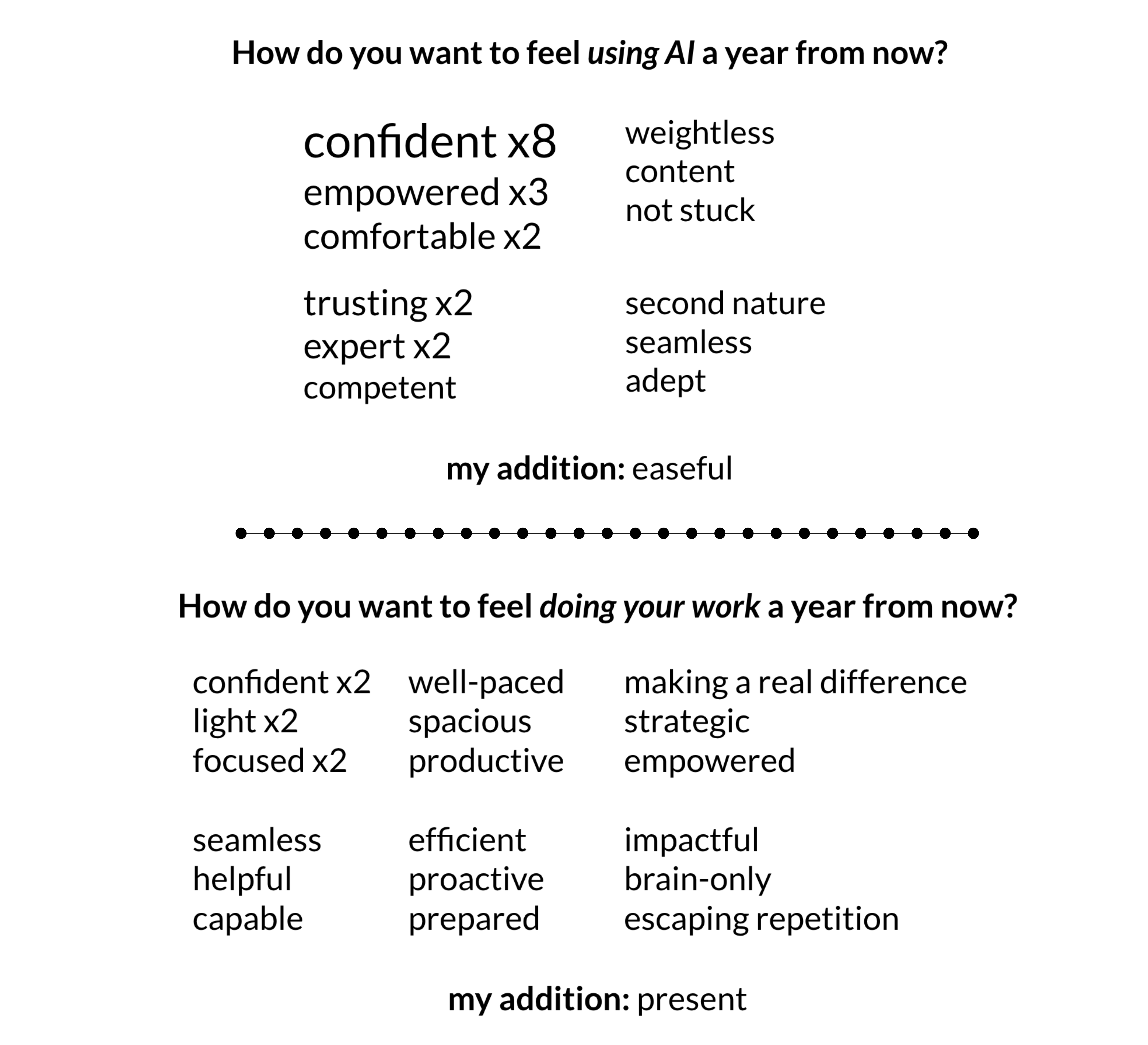
Those words became our north stars for AI integration—essentially, benchmarks that would tell us if the tech was actually serving us over time.
If we all say we want to feel lighter coming to work, and a year from now we’re “saving” 10 hours per week but feel more stressed than ever, we’ll know that we’ve stumbled onto the impact treadmill. But if we really feel those things we set out to feel—confident, empowered, light, spacious, comfortable—we’ll know that we’re onto something.
One of the biggest gifts you can give your team (and yourself) right now is space for this kind of intentionality. Otherwise, you may find yourselves sleepwalking into burnout without any anchor for what values-aligned AI integration actually looks like.
To date, the dominant AI-at-work narrative has mostly centered on mandates, mass layoffs, and the destruction of entry-level jobs—even though meaningful AI-powered efficiency and productivity gains depend on the innovation of staff throughout an organization.
What if we took a different path? What if leaps in productivity were redistributed to our teams as higher wages? What if the dividend of time were harnessed to power a four-day workweek, or more time for community-building, or job retraining?
These kinds of prosocial decisions are already being made in certain pockets of our economy. But there’s no guarantee that they catch on by default.
We get to design the shape of the container we all work within. And if history tells us anything, it’s that we need bold leaders at every level to model the art of the possible in order for real change to take root. (If you need some inspiration, just page through the history of the eight-hour workday and five-day workweek.)
Those tech CEOs we discussed earlier? They’re selling a vision of shorter workweeks delivered from on high—a gift from AI, bestowed by benevolent companies onto grateful workers.
I don’t think that’s how it happens. I think the path to a more human relationship with work runs through the choices we make right now. The messy, sticky, iterative work we do in our own days, on our own teams, within our own organizations and communities—that, to me, is the work of our time.
So: what would you do with 10 extra hours?
Thanks for reading the first edition of Purposeful AI. It’s great to have you here.
I welcome your thoughts and feedback in the comments (or in my DMs). If you found this useful or thought-provoking, you can support my work by sharing or subscribing:
You can also pledge future support at the bottom of this newsletter.
Some resources for deeper reflection
That HBR article about how AI can exacerbate burnout
The Inc. article about the “AI management tax”
A video module I created for NTEN all about the impact treadmill
A LinkedIn Live I did with Anthony earlier this month (Feb ‘26) about AI/burnout
Appendix: Time reallocation data from other nonprofits
For the nonprofit staff who reported experiencing AI-driven time savings (n = 58), these were the results:
52% – Catching up on backlog tasks
45% – Deep thinking or strategic planning
38% – Helping others / supporting team members
38% – Nothing specific; time just gets absorbed into the day
33% – More administrative work
31% – More warm-touch work
12% – Attending to personal matters (family, appointments, etc.)
10% – Learning or skill-building (AI-related or otherwise)
10% – More time away from my computer
(Note: this data comes from five nonprofits representing more than $130M in annual revenue.)