

Wander into any app store and the pitches practically write themselves. Todoist is for your to-dos. Notion is for your notes. Salesforce is for your relationships. The use case is obvious before you’ve clicked install.
What about AI? If you were just reading the headlines, you’d have to guess that it’s good for…everything. Well, not everything. But not nothing, either. It’s actually pretty hard to tell from the outside what AI “does.”
This is less of a marketing problem than a peculiarity of the technology itself: AI is a general purpose technology, which means it’s useful across a wide variety of tasks.
Unfortunately, that generality spells a problem for our ability to get real value from AI tools. I know this because I hear the same question in nearly every workshop I run, usually from folks who are clearly already trying: “But Remy…what is AI actually good for? Where can I use it in my day-to-day work?”
It’s an excellent question. And today I want to help you find the answer.
Being jazzed about AI’s mission-advancing potential in principle means nothing for your ability to realize that potential in practice. And developing a robust AI strategy demands a baseline understanding of what this technology makes possible in our work—which eventually lets us begin to use it in truly transformative ways.
The head, the hands, and the heart
In my last essay, I encouraged you to “embrace the plausible” with AI—meaning you shouldn’t let your ideas about AI’s limitations prevent you from discovering its real power when used well. For the purposes of this exercise, I’m going to take it a step further: I want you to momentarily forget about AI altogether. (We’ll get back to it shortly, I promise.)
Now, take a moment to think about a task or project you work on regularly—something that recurs week after week. Pick a familiar workflow, not something brand new to you.
Once you have a task in mind, break it down into 3-5 discrete steps on a piece of paper. Then, label each step as one of the following:
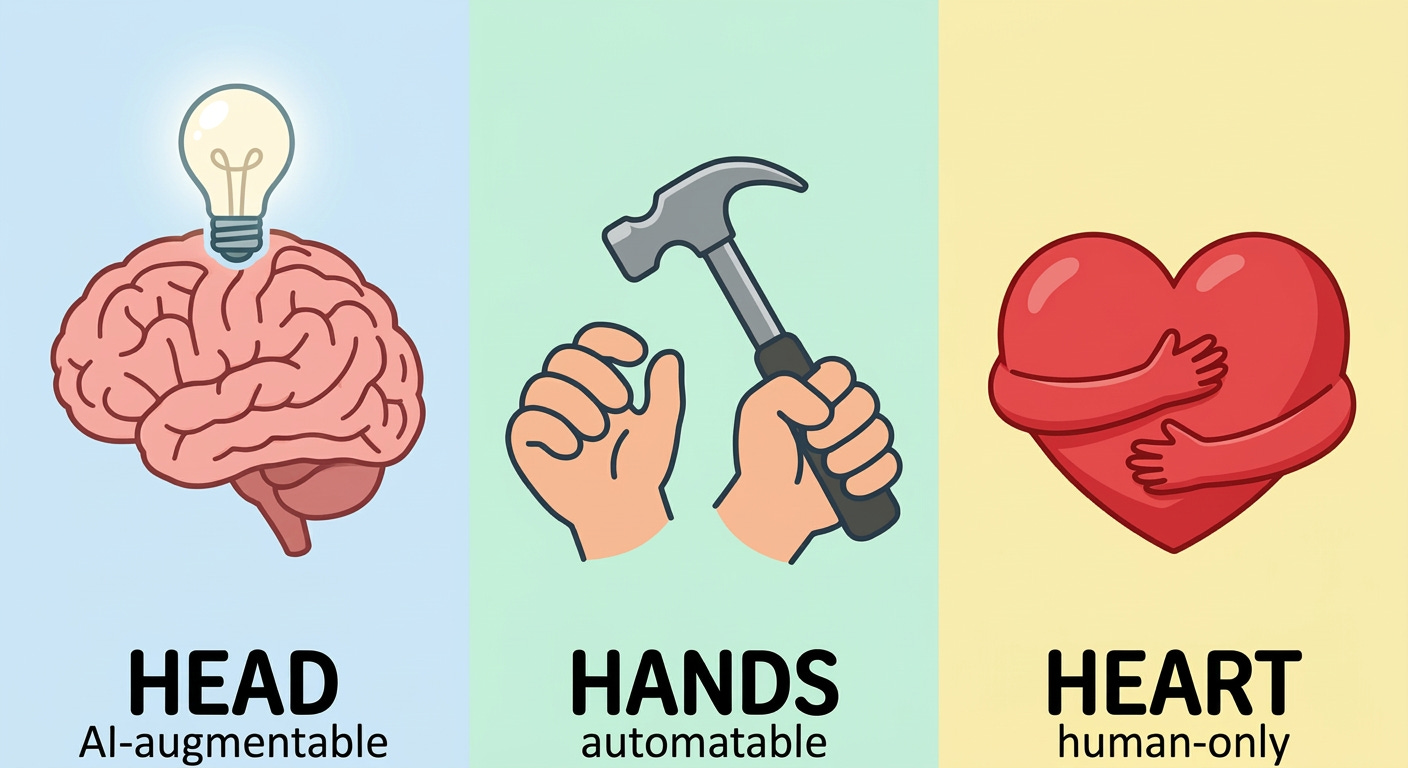
HEAD: driven by cognition/expertise. These are the parts of the task that really demand your judgment, experience, taste, and accumulated knowledge of organizational/situational context. Assessing whether a grant opportunity is a good fit for your organization is “head work.” So is deciding how to frame your theory of change to a new funder, or figuring out what a data anomaly actually means. These are the steps where your uniquely-trained brain is the irreplaceable ingredient; you wouldn’t hand them off to an intern or new team member without careful training and review.
HANDS: driven by manual labor/execution. These are the parts of the task that mostly depend on manual efforts, like moving data from a spreadsheet into Salesforce, updating a calendar with grant deadlines, or adding your organization’s logo to a slide deck. Nothing about these steps hinges on your unique expertise; they just require your time.
HEART: driven by the warm touch. These are the parts of the task that nonnegotiably require your humanness: your empathy, your presence, your relational instincts, your ability to read a room or hold space for someone, and so on. For example, calling a colleague to share difficult news and welcoming a program participant to their first event both involve a lot of “heart work.”
You might notice, as you attempt this activity, that many steps overlap with at least two of these categories. Drafting a grant application calls on your head and your hands; conducting an intake assessment with a new program participant calls on your head and your heart; writing thank-you notes to major donors calls on your head, your hands, and your heart.
But quite often, we struggle to decompose tasks into single categories mainly because our approach to completing work has become so automatic. We don’t pause to think through every invisible step in the process of drafting a meeting agenda—we just do it.
For this exercise to give us real value, it’s worth spending some time getting in the weeds of the task you’ve chosen. If you can’t categorize a step, take a closer look. Have you really gone as far as you can in breaking the task into its basic, discrete components?
To demonstrate what I mean, here’s how I might complete a first pass at this exercise for a community listening session:
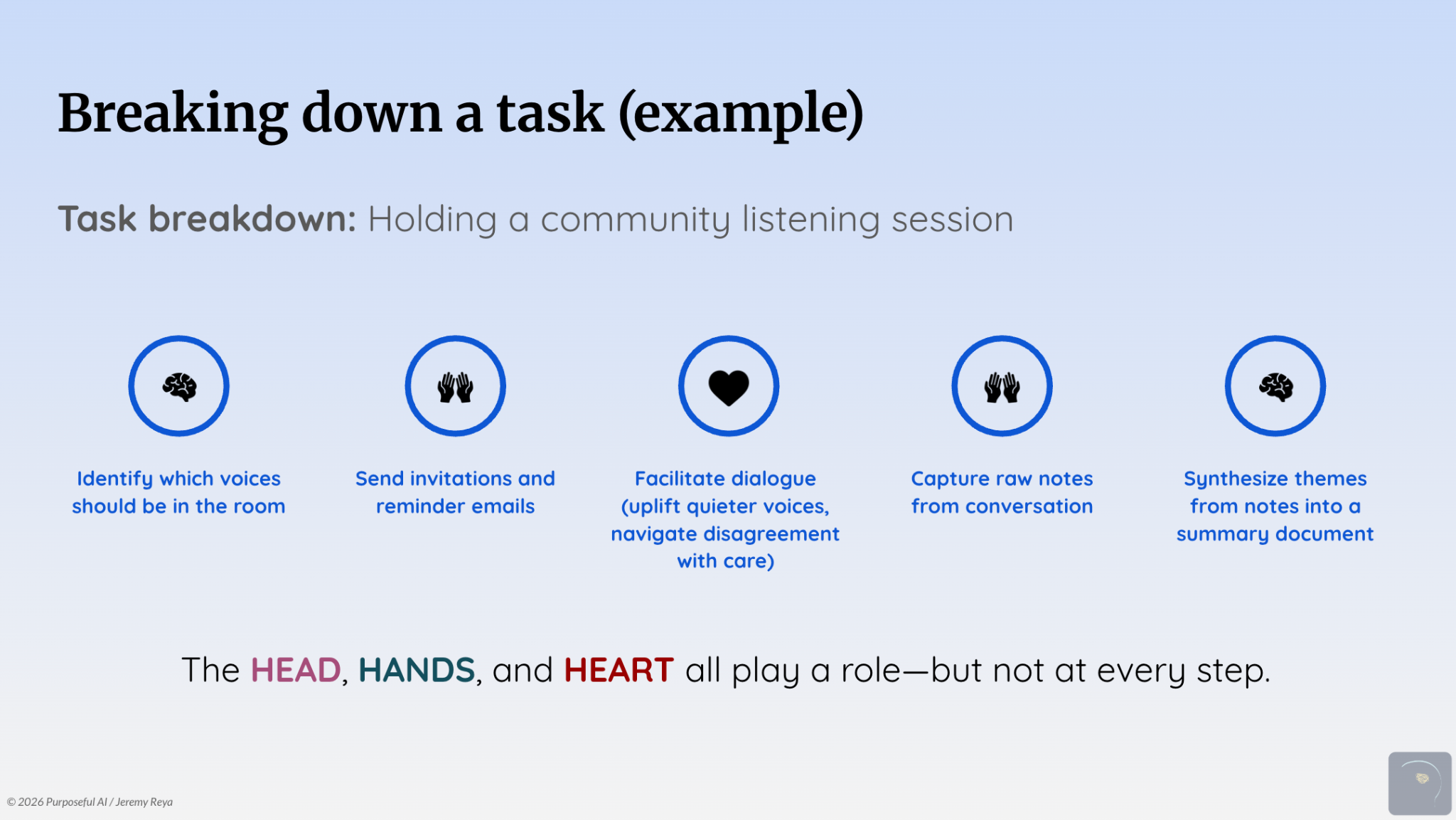
This isn’t a bad starting point—but if we look a little closer, it becomes obvious that the tasks we’ve identified could be decomposed further.
To demonstrate, let’s isolate just one step from the previous process: identifying which voices should be in the room for our community listening session. What really goes into executing that task, step by step?
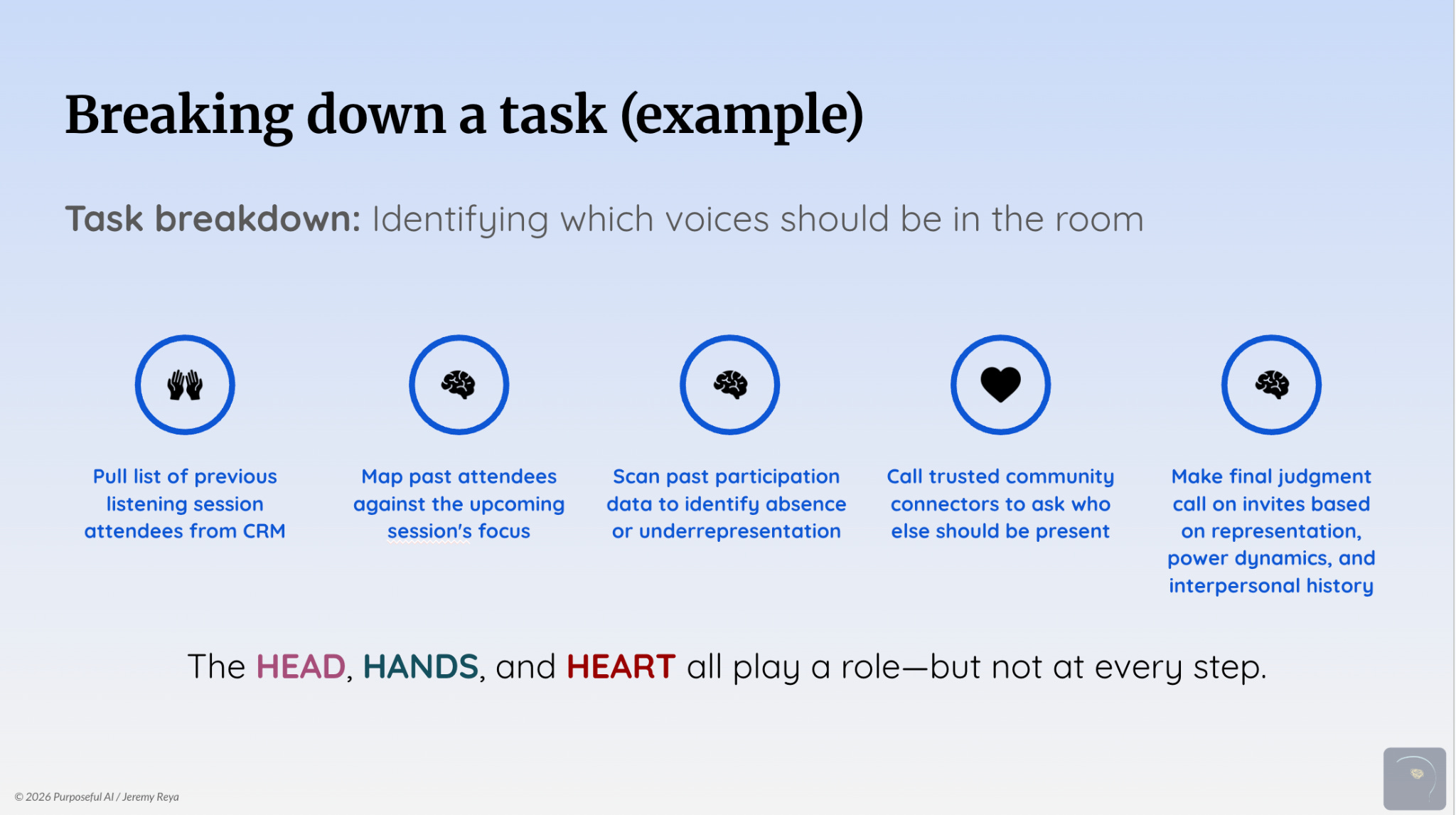
We could go even further with this kind of decomposition, but you get the gist: every task represents a series of subtasks that demand different kinds of work from us.
From mode to mechanism
With that process in mind, we can come back to the reason you’re reading this newsletter. Once you’ve gone through this exercise a few times, you should actually have a pretty clear roadmap for where to start experimenting with AI and automation.
I’ll explain.
The Head/Hands/Heart framework asks two very basic questions:
[Task] What do I do?
[Mode] How do I do it (currently)?
The logical next step is to figure out where AI and automation fit into this puzzle (if at all):
[Mechanism] How might we support the task using the technology at our disposal?
Given how AI and automation tools work, the breakdown we’ve just done gives us clues about where they might be especially helpful in our work.
Hands work (the steps that require your time, but not your judgment) tends to be repetitive and predictable. That maps well to automation tools, which are typically deterministic—they follow fixed rules, executing the exact same process every time. If a workflow fits the structure “Every time X happens, Y should happen,” you can probably use a tool like Zapier to run it automatically.
Head work (the steps that draw on your expertise, context, and pattern recognition) tends to require variable, situation-specific adaptation. That maps well to AI tools like Large Language Models (LLMs), which are probabilistic—they extrapolate from patterns to predict the most likely output, which is why two people asking the same question to an LLM can get meaningfully different answers.
And of course, heart work stays human-only, full stop.
Here’s how we might use AI and automation tools to augment our community listening session preparation efforts*:
Step 1: Pull previous attendee lists and contact records (Hands)
Automation: A Zapier workflow connecting Eventbrite to Salesforce automatically compiles historical attendee data the moment you start planning—no manual export required.
Step 2: Map stakeholder groups against the session’s focus (Head)
AI augmentation: You feed your list and a short description of the session’s goals into a Claude Project with organizational context already loaded in. You then ask it which groups are well-represented, which are missing, and what perspectives those gaps might leave out.
Step 3: Scan past data for who’s been consistently absent (Head)
AI augmentation: You drop your listening session attendance history into Claude and ask it to flag who’s been invited but rarely shows up. (Or you set up a Tableau dashboard that automatically surfaces these patterns based on live data.)
Step 4: Call trusted community connectors (Heart)
Mostly human, with a sprinkle of AI: This step stays mostly human—but if you break it down further, you see that you can use Claude to proofread a warm outreach message so that you’re not starting from a blank page when you pick up the phone.
Step 5: Make the final judgment call on the invite list (Head)
AI as thought partner: You bring your draft list back to your Claude Project and ask it to pressure-test it for blind spots, underrepresented perspectives, or power dynamics worth considering. The AI doesn’t make the final call—that’s all you!—but it helps you consider perspectives you might otherwise have ignored.
*I’ve chosen a few specific tools for this sample workflow, but there are many similar and complementary tools that can support this kind of workflow augmentation.
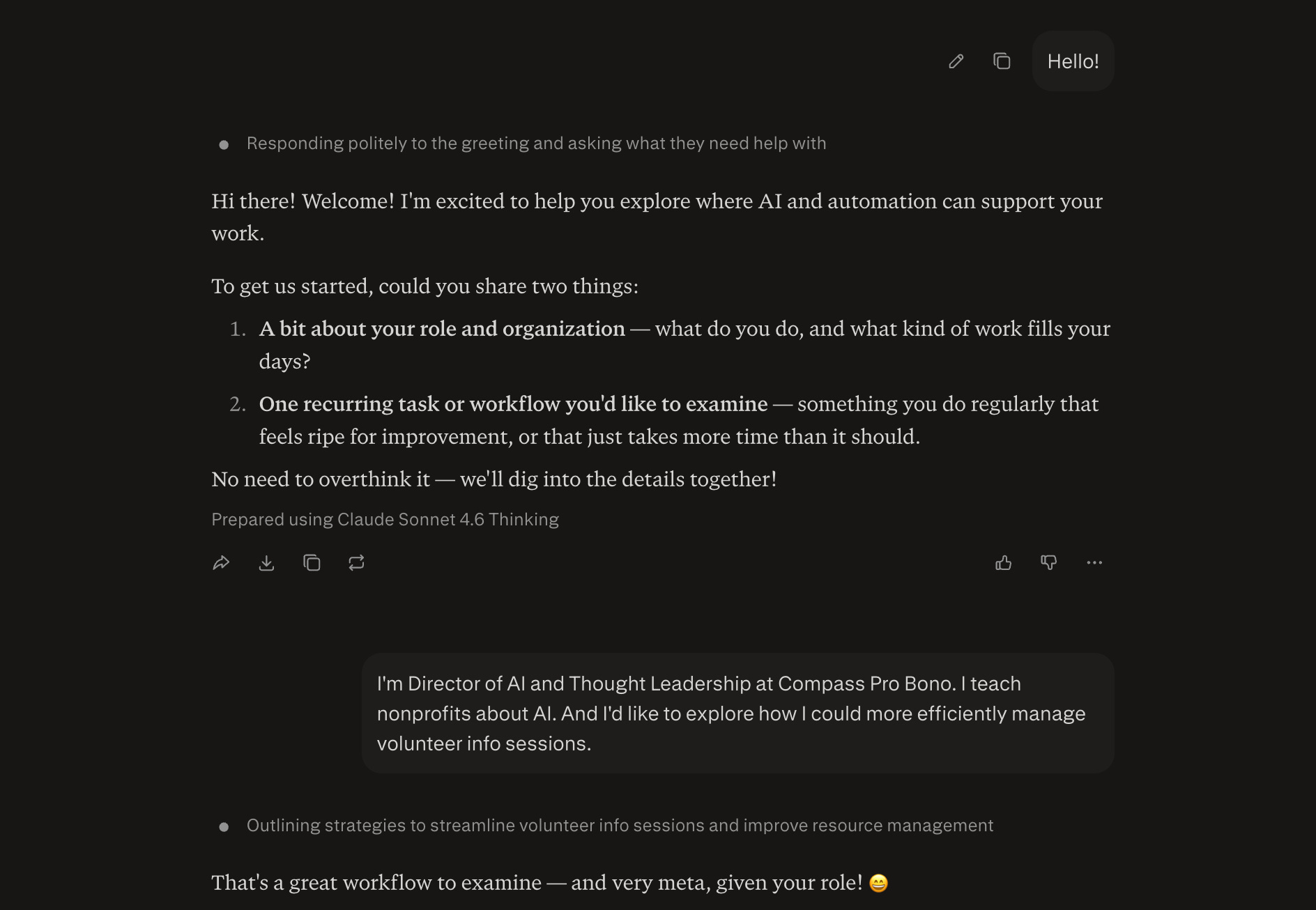
If you’re struggling to figure out real applications, you’re in luck: AI itself can be enormously helpful in the ideation process.
Once you’ve taken a pass breaking down a workflow using the Head/Hands/Heart framework, you can feed your breakdown directly into your LLM of choice and ask it to help you ideate additive ways to use AI and automation tools.
Here’s a prompt to do exactly that:
I’m attaching a breakdown of a common task I perform at work, with subtasks categorized using the Head/Hands/Heart framework. HEAD work is driven by expertise, judgment, and organizational context (i.e. it needs my expertise to be done well). HANDS work is driven by manual execution (i.e. it needs my time, but not necessarily my unique perspective/judgement). HEART work requires my humanness (i.e. it needs my empathy, relational instincts, or a warm touch that can’t be replicated by technology).
Interview me one question at a time until you fully understand the scope of the work (i.e. how I achieve the intended outcome). If necessary, challenge my labeling—I might not realize where a task description is overly broad and could actually be broken down further into Head/Hands/Heart.
Once we have a set of discrete, labeled steps, help me identify specific AI tools or automation approaches that could augment the Head and Hands work. Be specific about platforms and techniques where you can, and prioritize these ones: [list out any AI/automation tools you already use or have access to]. If necessary, do supplementary web research to home in on the most recent features of these tools.
Here’s a bit about my role and context to help you out: [describe your role, your organization’s mission, and 1-2 sentences about what success looks like in your work].
To make this as easy as possible for you, I’ve also designed a Perplexity Space that walks you through this process step by step. You can access that tool here.
What this work makes possible
Going through this exercise does something else for us, too—something I didn’t fully anticipate when I first started running it in workshops.
When you decompose your work into Head, Hands, and Heart, you stop seeing it as a monolithic to-do list and start seeing it as a bundle of distinct activities, each of which makes a different kind of demand on you. And once you see the bundle clearly, a new set of questions opens up: “Which of these pieces actually need me, and in what ways? Which pieces are holding me back from doing more of the work that does?”
Having now walked hundreds of people through this exercise, I’ve found that it often leads to micro-epiphanies. You may see for the first time just how many of your daily activities don’t actually “need your brain.” You may find that you’re not doing nearly as much “heart work” as you expected—even if that work is what drew you to your organization’s mission in the first place. You may find that you really enjoy the “hands” work and want to do more of it! Or you may find something entirely different.
Whatever you find, it matters. Those realizations can enable critical conversations about the nature of our work, and where technology actually fits into it. Those conversations will be essential as we try to build good things with AI.
We are in a rare moment. We have the opportunity to be imaginative not just about what AI and automation can do for our missions, but about what we bring to our missions that AI and automation fundamentally cannot replicate. That’s where this exercise actually points (and where we’ll pick up this conversation next time).
Our fundamental goal is a clearer vision of what our mission actually asks of us—and a clearer sense of how technology can help us do more of that work, not less of it.